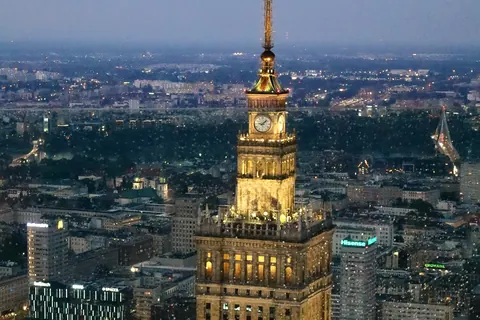
The Palace of Culture and Science is a notable high-rise building in central Warsaw, Poland. With a total height of 237 metres, it is the second tallest building in both Warsaw and Poland, the eighth tallest building in the European Union and one of the tallest on the European continent. At the time of its completion in 1955, the Palace was the eighth tallest building in the world, retaining the position until 1961. Between 2000 and 2002, it was also the tallest clock tower in the world.
Inspired by Polish historical architecture and American art deco high-rise buildings, the Palace of Culture and Science was designed by Soviet architect Lev Rudnev in the spirit of the "Seven Sisters".
The Palace houses various public and cultural institutions, including theatres, museums, universities, a cinema, a concert hall, a public swimming pool, and the offices of the Polish Academy of Sciences. The building is decorated with sculptures representing the fields of culture and science. The main entrance features sculptures of the astronomer Nicolaus Copernicus, by Ludwika Nitschowa, and the poet Adam Mickiewicz, by Stanisław Horno-Popławski. Since 2007, the PKiN has been listed in the Registry of Objects of Cultural Heritage.
Sources
- Wikipédia (fr) : Palais de la culture et de la science (Varsovie)
- Wikipedia (en): Palace of Culture and Science
- Wikidata: Q167566
- Official website
Text: introduction of the Wikipedia article Palace of Culture and Science, under the CC BY-SA 4.0 licence (authors: article history). Facts: Wikidata (CC0). Coordinates: Wikidata, map background © OpenStreetMap contributors.